Customer Experience, Small Business
At thirty years old, I’ve been well aware of George Zimmer and his Men’s Wearhouse brand probably since renting my first tux for high school prom. Since that awkward and memorable evening, I’d say I’ve rented or purchased items from Men’s Wearhouse between 5-10 times.
Well, recently I got fitted for another tuxedo at Men’s Wearhouse for a wedding, and it was memorable and awkward in a much less endearing way. I stopped in to get fitted, and 65 minutes later I left frustrated and annoyed. It wasn’t until I parked at home that I recognized the silver lining of the situation. I had had a negative customer experience, but the reasons it was negative could easily be translated into valuable lessons – which, subsequently, I thought would make a very nice blog post. (Sidenote: Sometimes I rewrite sentences to avoid saying “had had” or “that that”, but I’m working to embrace it and put more trust in the reader)
So here we are.
I arrived at Men’s Wearhouse and wandered over to what I deemed must be the rental section. I had never been to this particular store, and while there wasn’t anyone there to greet me, the stores are all roughly the same so I was able to quickly find the rental counter and make my way over there.
After a few minutes of standing around looking lost and puzzled among a handful of other equally confused guys, one of the busy clerks told me that I should add my name to the sign-in list.
Sign-in list? Okay, I’ve never been to a Men’s Wearhouse with a sign-in list, but sure. Why not? So I signed in, and after another few minutes, one of the guys waiting near me said “You’re gonna wanna fill out one of those forms” as he pointed at a note-pad with some sort of rental agreement form on it. Something about the tone he delivered this directive with gave me the impression that I was in for a treat.
My experience continued as such– vague and delayed instructions offered to me lazily by other gentlemen who also had better places to be.
After 15-20 minutes of standing around, I gathered that most of the other gentlemen hadn’t yet been helped either. And because I knew who had been waiting longer than I had, I surmised that I could safely run next door to Target to grab a few things and be back before they called my name.
I notified one of the (well-dressed) attendants that I’d be back shortly, and asked if my assumption about my position in “line” was correct. Her exasperated response was that they were working as quickly as they could, they wouldn’t come get me at Target, and if I wasn’t here they’d have to move on.
Noted.
After returning from Target, I resumed standing about with the other gents watching slowly as one after another was called for various measurements and fittings, and eventually my name was called. I stood awkwardly in between floor displays as they proceeded to take one measurement every few minutes in between rushed trips to the back to grab a different size shoe or shirt for other renters.
 During my analysis while waiting I thought I had figured out that one employee was handling measurements, another was responsible for assisting the guys picking up tuxedos, and the last was collecting deposits; but when it was my turn to be measured my careful observations quickly fell apart. There was no longer a discernible rhyme or reason to their “system”.
They all were sort of doing each role. And the unfortunate result was none of the roles were being done effectively.
In fact, at one point they had taken measurements, written some numbers down and walked away to leave me standing long enough that I had to seek someone out just to ask “Am I all set here? Or, is there something else you need?”
There was more they needed. I resumed my ranks among the other impatient, dejected patrons.
Eventually, someone came back, summoned me again, and after trying on some shoes I gave them my credit card and they eagerly accepted my deposit. I got my receipt and as I (equally eagerly) turned to leave, I realized we hadn’t discussed where or when my Tuxedo would be ready. The wedding would be in Michigan, and I live in San Diego. The logistics of picking up my Tuxedo in a state other than the one in which I had been fitted seemed to be an insurmountable obstacle for the attendee at the rental desk.
So, I quickly googled the stores in the greater Lansing area and decided which one would be best for me, located the store number, and spoon-fed her the details to finalize and update my reservation. Then I quickly left, without an ounce of confidence that my tuxedo would arrive where I needed it, or in proportions that matched my own.
Listen, I’m not an unreasonable guy. And in the grand scheme of things I realize that 65 minutes isn’t that long. But that’s also kind of the point. This minor interaction is a fundamental part of their business. Men’s Wearhouse sells suits and men’s clothing, but they also do a fair amount of business renting tuxedos. So for a business who does this regularly, I’d expect them to have worked out an iron-clad system to get me in, fitted, and out.
At it’s very core, I’m paying $200 to rent clothing that other people have worn for a single evening. If I’m willing to accept that, it seems like making my experience as fluid as possible is the least they can do, right?
Yes, I gathered that they were busy. And I pieced together what I perceived to be the process. But as a customer, I want to be told exactly what is happening, and I want to be kept up to speed if that changes.
We could probably dive in to their whole rental process and identify a number of areas where it could be improved, but before we even go there I want to call out a much lower hanging piece of fruit for them. Communication.
(Nevermind the fact that I rented a Tuxedo 3 months prior and they insisted that I still needed to come in to be measured again…)
If Men’s Wearhouse had simply said “Hey, welcome, we’re really busy right now. But if you sign up here, and start filling out this paperwork, we’ll call you when we’re ready to get your measurements. We’ve got 4 people ahead of you, I’d guess it’ll be 30 minutes before we get started with you.” I think I’d have been just fine with it.
I don’t expect perfect service. It doesn’t have to be immediate. I totally understand what it’s like to be stressed, busy, or overwhelmed. But I’ll be much quicker to forgive mediocre or even poor service if you set the right expectation with me, acknowledge ownership and communicate clearly with me as things change.
I don’t want to bash Men’s Wearhouse too thoroughly, because they’re probably doing some things really well. I recognize that this was a single isolated experience. And because they’re a massive organization, there are things like this that can probably be overlooked without severe long term damage.
But that’s rarely the case for small businesses. It’d almost certainly have a much longer-lasting impact for my business. What about yours?
Things won’t always be perfect. And inevitably some of your customers will end up frustrated. But if you’re transparent with them you’ll find that they’re much more likely to accept your imperfections in stride. Or even go so far as to defend you to others (should you need it).
Sidenote: The Tuxedo arrived at the store it was intended to. And it didn’t fit originally, but the in-house tailor was able to make a few modifications and we ended up pretty sharp-looking bunch.

Customer Experience, Keap, Lifecycle Marketing, Marketing, Small Business
The first thing you need to know is that Lifecycle Marketing transcends Infusionsoft. It’s a stable concept for small businesses everywhere. The common mistakes I’m going to outline here are not unique to Infusionsoft users. They’re prevalent throughout the small business community at large.
Lifecycle Marketing (or LCM as I’ll call it) is the strategy around which Infusionsoft encourages you to build your business. As a consultant and trainer at Infusionsoft, I saw it work time and time again. And, I also got to see plenty of businesses who couldn’t stay afloat, or just struggled because they didn’t adopt it. Well, they either didn’t embrace it, didn’t understand it, or didn’t execute it. Let me outline 3 icebergs that could sink your LCM ship.
 For those who don’t know, Lifecycle Marketing involves designing a process, or several, that will take your customers experience into account during every single step along their customer journey. This means that everything from opting in to your list, all the way to making repeat purchases has been planned for. Learn more here.
1. LCM isn’t Static
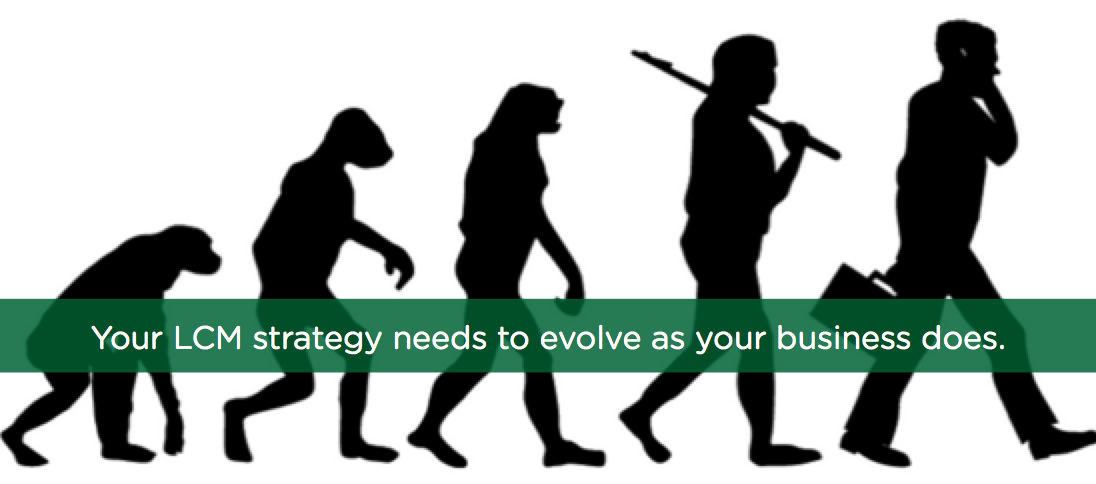
 It needs to evolve. As your business changes, so to should your lifecycle marketing strategy. Too many businesses work through their LCM strategy, and then never revisit it. The reality is that small business lives in a constant state of flux. Your business looks different today than it did three months ago, or a year ago. It’s important to carve out regular time to revisit your LCM strategy and make sure that it reflects your current needs.
Action: Carve out a full day once a quarter to revisit and audit your LCM strategy. See what has changed in your business, and if anything needs to change in your LCM approach.
2. Too Simple to Work
 I’ve seen it happen over and over. A small business owner is presented with the concept of Lifecycle Marketing and they’re underwhelmed by the graphic, or the explanation, or both, and so they dismiss it. Well, the reality is that the graphic isn’t all that impressive. I don’t think too make people look at it and say “Oh, SELL, that’s the piece I’ve been skipping.” But I do think there is value in the LCM graphic, and to me it’s in the connections between the stages. Far too often people tend to look at Lifecycle Marketing as these independent stages that comprise a strategy. When in reality, the real magic of an LCM strategy is in how the stages tie together. The intentional focus on transitioning prospects from one stage to another can be the difference between prospects becoming customers, or slipping between the cracks.
Action: Don’t take the graphic at face value. Look at how your LCM stages tie together, whether or not they were designed with respect to one another, and whether or not you’re creating a cohesive customer experience.
3. No Natural Nurture
To me, the easiest thing you can do to get more customers is develop and implement a nurture funnel. There are generally two ways to get more customers- either by getting new leads, or by converting the leads you have at a higher rate. Nurture is all about doing more with what you already have. (I feel like I’ve said that before) The reality is that most people agree with this, but very few actually do it. The biggest reason people aren’t doing this is because they don’t know HOW to do it. They’re confronted by question s like: Where do I begin? And What do I say? How much is too much? And if they can’t immediately answer, then they end up paralyzed and nothing gets done.
Well, I’ve got 11 questions you should walk through to help design a nurture funnel that works, and it starts with “What is the GOAL of my nurture?” (Hint: It may be more complex than ‘buy something’) If you’re looking to build, or refine, a nurture process, you can download the 11 questions here.
Action: Start with these 11 questions. Then find a tool (I recommend Infusionsoft) and build a nurture funnel that automatically follows up with prospects, and builds a relationship, provides value, and fosters trust.
There isn’t a single surefire indicator for whether or not a business is going to become a wild success, but having a solid Lifecycle Marketing strategy, and executing on it, will certainly set you up for smoother sailing.
Oh, and if you use Infusionsoft, check out my LCM: Real Life course – it’s all about bridging the gap between LCM theory and the actual campaigns that support it. And you can get the first module for free!

Customer Experience
I learned two things today. I learned that we have an avocado tree in our yard. And I also learned that avocados grow on trees.



Okay, so technically its in the neighbors yard, but it leans over our fence and we are 100% going to benefit from the tree once the avocados are ripe. (Pro-tip: I don’t personally like fresh tomatoes, so I make guacamole with diced naval oranges. Second Pro-tip: Also delightful with pomegranate seeds)
“Great, Greg, thanks for rubbing that in our non-bearded faces.” I know, I know, trust me, there’s a point.
I’m telling you all this because I had a realization when I learned that it was an avocado tree. It occurred to me that I didn’t know avocados grew on trees. I’m 30 years old, and this week was the first time it occurred to me that avocados grow on trees. I mean, sure, it makes sense. And I guess if you had asked me, I probably would have guessed that they grew on trees, but I had never devoted an ounce of energy into thinking about something so obvious.
This got me thinking. There are things like that throughout the rest of our lives as well. Things that are so obvious that they can be hard to see.
A few weeks back, Sara and I were back in Michigan for a wedding in Kalamazoo (possibly best known as the hometown of Derek Jeter or for its mention in the literature of Dr. Seuss). And before heading back to the wedding I had to contact the Radisson we were staying at to shorten our trip by a night. We had decided to spend one extra night with family, and one fewer night at the hotel.
So I called the hotel, and shortened the trip, here is how the conversation went:
“Okay, Mr. Jenkins, we’ve adjusted your trip. I have a new reservation confirmation number for you. Let me know when you’re ready.”
“Oh, actually, I’m driving right now and am not in a position to write it down. Would you mind just emailing it to me?”
“I’m afraid I can’t do that. Our system only sends the initial confirmation. Sorry.”
“Oh. But, you can see the confirmation number, right?”
“Yes sir.”
“And surely someone in your office has access to email, right?”
“Yes, of course, but the system we use doesn’t send updated confirmation numbers, only the original number is sent out.”
“Right. Nevermind.”
I backed off at that point, gave a heavy sigh, and decided to roll the dice and travel without a confirmation number (because I like to live dangerously).
Of course they have email. And of course she could have written the number down herself, and sent it to me. But this didn’t even occur to her. And it’s not her fault. She is a product of the climate she works in, and has never been empowered to think critically or to take ownership and just do what was best for the customer.
This was a valuable reminder for me that even with all the advancements in technology:
People are still our safety net.
People can rationalize. We can think creatively. And we can empathize. This is what sets us apart. You, and the people you work with, are the fail-safe when something doesn’t fit within the system you’ve built.
Automation is most powerful when used to multiply people, not replace them.
I’d love to hear if you’ve had a story like this, if you have a guacamole recipe, or if you feel Kalamazoo is best known for something else.

 During my analysis while waiting I thought I had figured out that one employee was handling measurements, another was responsible for assisting the guys picking up tuxedos, and the last was collecting deposits; but when it was my turn to be measured my careful observations quickly fell apart. There was no longer a discernible rhyme or reason to their “system”.