The Education Edge

The Education Edge

Have you heard this clip where Bob Newhart explains Baseball to someone who has never played, or even seen it?

The thing I like about this clip is that I know how baseball works – so it makes sense to me. But hearing it explained to someone for the first time makes it sound absolutely absurd.

Things we don’t understand feel confusing and overwhelming.

And things we do understand tend to feel familiar and comfortable.

You’ve gotta learn the rules to play the game.

Education offers you a concrete advantage.

Let me explain:

I’ve been using AccessAlly for a few months now, and I’m noticing an interesting trend – the more I “get” the software, the more valuable it becomes.

For the first few weeks it wasn’t doing what I wanted it to do, and it felt…clunky.

My instinct was to blame the software (I’m a smart guy, so it can’t be me, right?) – but I persisted anyway.

I dedicated myself to reading articles and watching videos. I immersed myself in the AccessAlly community, asking questions and then working hard to try and understand the guidance that was offered.

The more I understood it, the more it did what I needed.
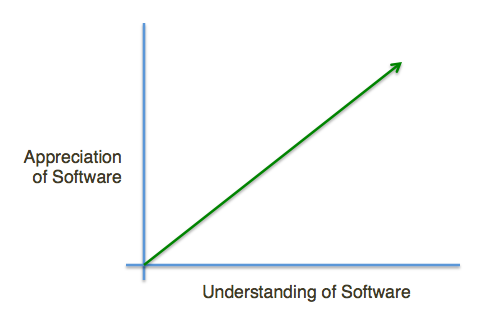
The fascinating thing about this is that the software isn’t really changing (maybe little updates here and there), but rather I’m the one who’s evolving

I realized that much of my frustration was stemming from misaligned expectations – I had been asking AccessAlly to do things it wasn’t designed to do.

I hadn’t taken the time to learn the rules of the game I was playing.

I had hired a surgeon and was asking her to fly an airplane.

Can you butter your toast with a chainsaw, sure, probably – but that’s not what chainsaws are best at.

In order to maximize the results you get from a tool, you have to know how that tool is intended to be used.

My relationship with AccessAlly isn’t unique, I had this same experience when I started using Zapier, and I’d bet it parallels the one you have with ~Insert.SoftwareHere~.

I spend a lot of my time in the Infusionsoft ecosystem, and I’ll be the first to say that it’s far from perfect.

The software definitely has bugs from time to time.

I regularly see comments in the various Facebook groups and Infusionsoft Forums from people who are frustrated because Infusionsoft doesn’t do X, Y, or Z.

They’ve tried everything and it just isn’t working.

Then after a few clarifying questions, and some insightful recommendations -the user has their solution and is on with their day.

This happens over and over and it’s a definite testimony to the powerful and support Infusionsoft user base (one of Infusionsoft’s greatest assets, in my opinion).

The only issue is that there are just as many problems that are never posted publicly, and never get the benefit of a group brainstorm.

There are users every day who run into an apparent brick wall, and they wind up exasperated because they think they’ve explored every possible solution; or they’re convinced that there’s a bug, simply because the software isn’t doing the things they expect.

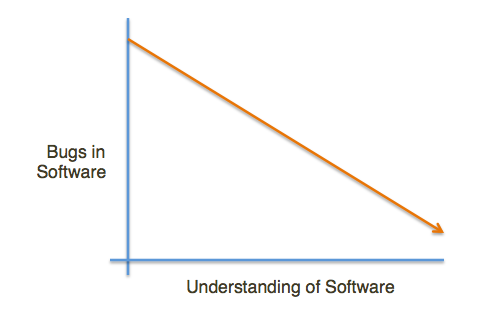
But I wonder what percentage of “bugs” are not bugs at all, and are actually user error? Or a simple misunderstanding, or incomplete understanding of how a feature is intended to work?

I’m definitely not trying to throw anyone under the bus, but I am clearer than ever that the more thoroughly you understand a software, the fewer “bugs” you run into.
You still with me?

As your understanding of the software continues to develop, so too does your comfort and confidence in testing things, isolating issues, and troubleshooting them on your own.

It’s through this process that you learn to identify the different features inside Infusionsoft, and then depending on what you need to happen, you now have the comfort to select the right tool for the job.

The more you understand the software, the more quickly you’ll be able to recognize actual bugs, and you’ll waste less time trying to figure out if you made a mistake.

To steal and immediately butcher a quote from my friend Scott Richins, there are rules to the game; and the more you understand the rules – the better you’ll be at the game. (Watch the original from Scott)

Third Party Advice

Another reason that education is so important is because it can protect you.

Full disclosure, I added this section after I originally published the post – because of an email I received from one of my blog subscribers. Here’s the email:
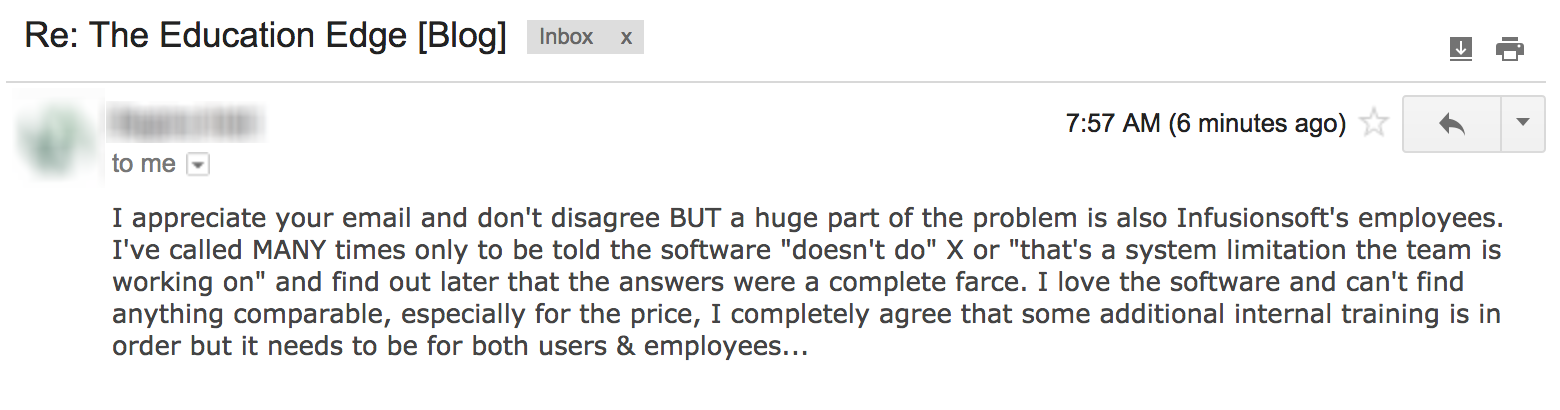
Education protects you from lousy, or inaccurate advice.

When you don’t feel like you know much, it’s easy to think that everyone you talk to must know more than you.

And that’s not always the case.

The Path Forward

So, education is the key, right?

But I fully understand that you can’t just stop what you’re doing and devote yourself to studying how Infusionsoft is supposed to work, and running through practice scenarios, and mining for hidden “gotchas”.

In fact, I probably wouldn’t recommend it even you did have that kind of free time.

If you’re still with me, and you’re asking “What then, Greg? What do you recommend I do?”

It’s this: The IS Starter Kit

This course is designed to establish the baseline foundation of confidence that is required for using Infusionsoft.

The things in this course are important, I have no doubt about that – but what’s more important is that it helps lay out the rules to the game.

It helps you understand where the boundaries are in Infusionsoft; what’s reasonable to expect, and what isn’t.

Once you know the rules, you can develop a strategy.

You can determine how much of it you want to do yourself, and where to bring in specialists.

The best thing about education is that you get to take it with you. The more you understand the tools you have access to, the more easily you’ll recognize the opportunities to use them, and the more capably you’ll be able to select the right tool, for the right now.

And you’ll never butter your toast with a chainsaw again.
7 Things I love about Wistia

7 Things I love about Wistia

Wistia is what I use for video hosting.

There are definitely less expensive options, but since video is a big part of my business I decided this was something I was willing to invest in.

It’s one of the most expensive tools I use for the last three years, but I love it, so I happily pay each time my annual payment comes around.

Here are 7 reasons I love Wistia:

(You can read about it, or jump right to the video)

1. Annotation Links

Annotation links are a slick little feature that allow you to add call-out links during your video. So, if your video is talking about a specific tool, website, or article you can link out to it at the exact time you mention it.

2. Turnstile Lead Capture

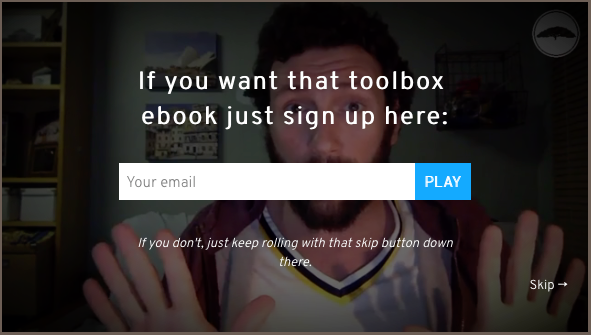
I love the turnstile lead capture feature. Basically this allows you to gate your video, so that the viewer is required to enter their email address if they want to watch it; OR, you can use it like I do, as a mid-video option where the viewer can subscribe for notifications when there is more content like that. I like that it also gives viewers the option to skip if they’re already subscribed, or not interested.  (more on this feature)

3. Email Marketing Links

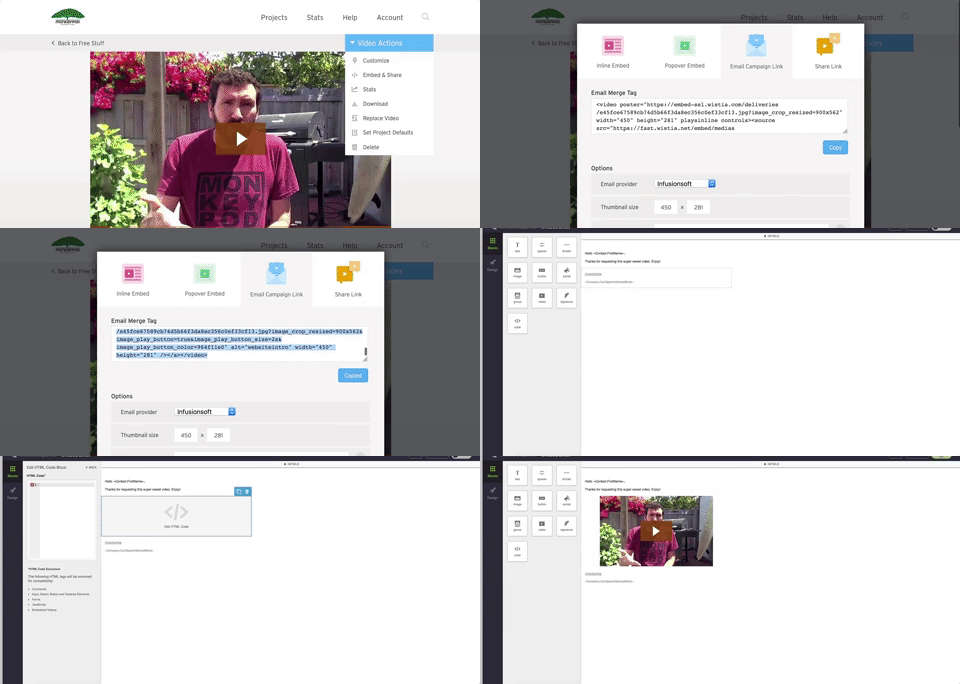
Wistia gives you specific tracking links that you can use with your email marketing platform. This integration works with Infusionsoft, as well as 25 other email marketing tools. Basically, this feature gives you a specific link you can use in your emails that will pass contact details through to the destination page, so that Wistia can attach that viewers behavior to their email address, rather than recording it as anonymous data. (more on this feature)

Note: This feature does not allow you to trigger actions in your CRM based on how much of a particular video someone watches, for that, I use PlusThis video tracking.

4. Reporting and Analytics

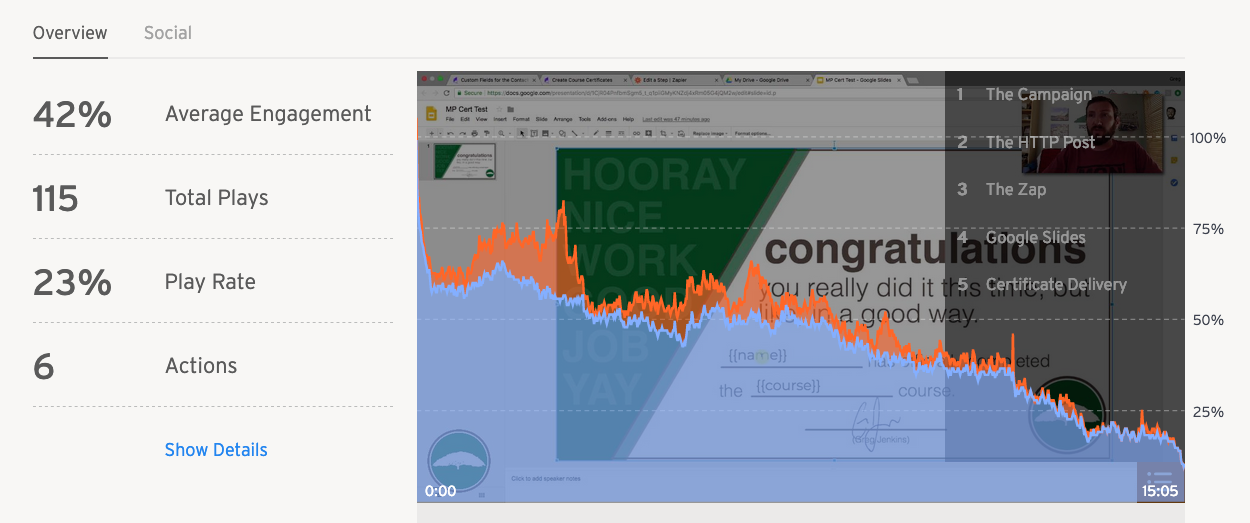
Wistia has built in video tracking to let you know how your videos are performing. You can measure views on an individual basis, as well as aggregate trends across your entire account. In addition, if someone has engaged with a turnstile, or arrived on the page via your specific email marketing links, then you’ll be able to see how much of a certain video key individuals consumed.

5. Chapter Markers

Wistia allows you to quickly and easily create chapter markers, which helps break up longer videos and lets your viewers jump to the section they’re most interested in. This is great for content where you have clear transitions between bullet points, or courses where you cover a variety of topics in the same video. (more on this feature)

6. Playlists

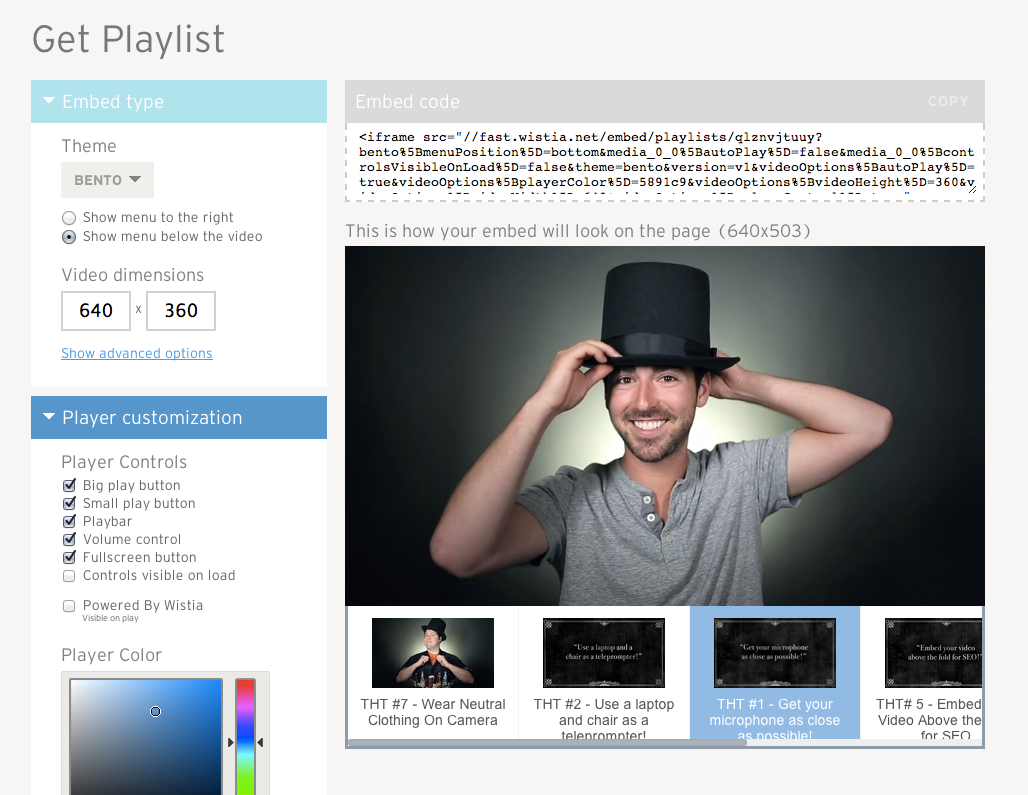
When website real estate is limited, embedding a playlist is a great way to give people a series of videos, without a massive amount of scrolling, or displaying all your videos in a grid. In Wistia, you organize your videos in folders, and if you’d like you can grab an embed code for that entire folder, resulting in a “playlist” of videos.

Wistia also gives you a four options for how you’d like the videos in the playlist to be organized, Bare, Slide, Tab, and Bento. (more on this feature)

There are a few limitations to Wistia playlists that you should be aware of, they’ve outlined the biggest concerns here. An additional restriction is that because the playlist has it’s own embed code, I don’t think it would easily work with the PlusThis video tracking feature I mentioned earlier.

7. The Company

So, I actually had three things left on my list – Wistia’s Culture, their Customer Service, and their educational resources (very useful stuff); and so I bundled those three together as “The Company”. Wistia is an organization that I feel good about supporting. Here’s why – I’ve felt genuine care and empathy with very interaction I’ve had with their support team. I believe they communicate with transparency, and own their mistakes. I blogged about an example of this a few years ago. The last reason, is that they have a brand personality.  They’re not corporate, and they don’t take themselves too seriously. I can respect a company who takes an otherwise bland software and adds their own flavor and a little humor.

Want to see these features in action?

11/8/2018 Update – Split Testing

Just when I thought I couldn’t love Wistia and harder, they go and release A/B testing. (More here)

Spoiler: It’s basically everything I dreamed of and then a few things I didn’t even know I wanted.

Contact Page Microexperiment

Contact Page Microexperiment

The clickbait title of this post would have been something like “How to triple conversions overnight with one small tweak” or “The 30-second video that created the 350% Opt In Spike”.

But I’m not a clickbait type of guy, and this isn’t a clickbait type of post.

Here’s the deal – when I started Monkeypod I built my website. And then I moved on to the next project. And the one after that.

That’s how most businesses operate, right? Build, launch, move on.

In my experience it’s hard enough just doing that.

But this year I set a goal for myself “Do less new stuff, and make my existing stuff better.” (It’s harder than you might think.)

So, with that in mind – I’ve been revisiting my website, and all the stuff I built 3 years ago to ask “Why’d I do it this way?” and “How could it be better?”

In February I asked that about my Contact Us Page – a simple page, creating modest results.

In 2017 I averaged 2 submissions and 1 new contact a month. When I saw those numbers I genuinely didn’t know if it was good or bad. I had no context for it.

So, I decided to mix it up (can’t learn if we don’t try, right?) and I added a 30 second video to that page.

Two months later I had tripled the number of monthly submissions I was getting.

Here’s the deal:

Listen – I certainly won’t pretend to have all the answers.

But from my experience I think that most small businesses spend the majority of their time working on moving things forward, and building whatever is next – which is certainly admirable, but I’ve found revisiting the stuff I’ve already built can be equally rewarding.

Sometimes fanning a fire that’s already burning is easier than starting one from scratch.

(I’ve been watching Survivor lately – so I’ve got firestarting on the brain.)

The Tea Kettle Lesson

The Tea Kettle Lesson

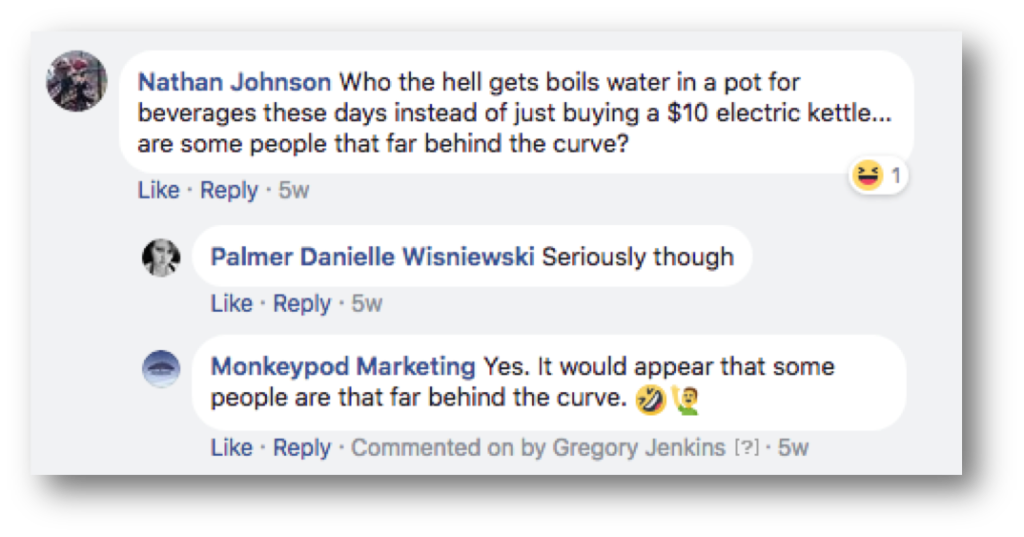
A few months ago I posted a little story about how a thrift store Tea Kettle had blown my mind.

You can see the whole post below, or here, but I’ll give you a quick recap: Sara and I were at a thrift store, and I saw a tea kettle for a few bucks – and bought it.

We make coffee or tea nearly every morning – and we’d been boiling the water in a pot (like heathens, apparently), and I figured it was time we owned a proper kettle.

Immediately the kettle revealed itself as a good decision.

I had figured that the noise it makes when the water starts to boil would be useful, and it was, but what surprised me was that the water actually boiled faster too.

So, in addition to the convenience of knowing exactly when the water boils from anywhere in the house, now you’re telling me that we go from zero to caffeine that much faster? Here, take my money.

I wrote the Facebook post because it was a good reminder that using the RIGHT tool for the job makes a big difference.

And clearly I had found the right tool, right?

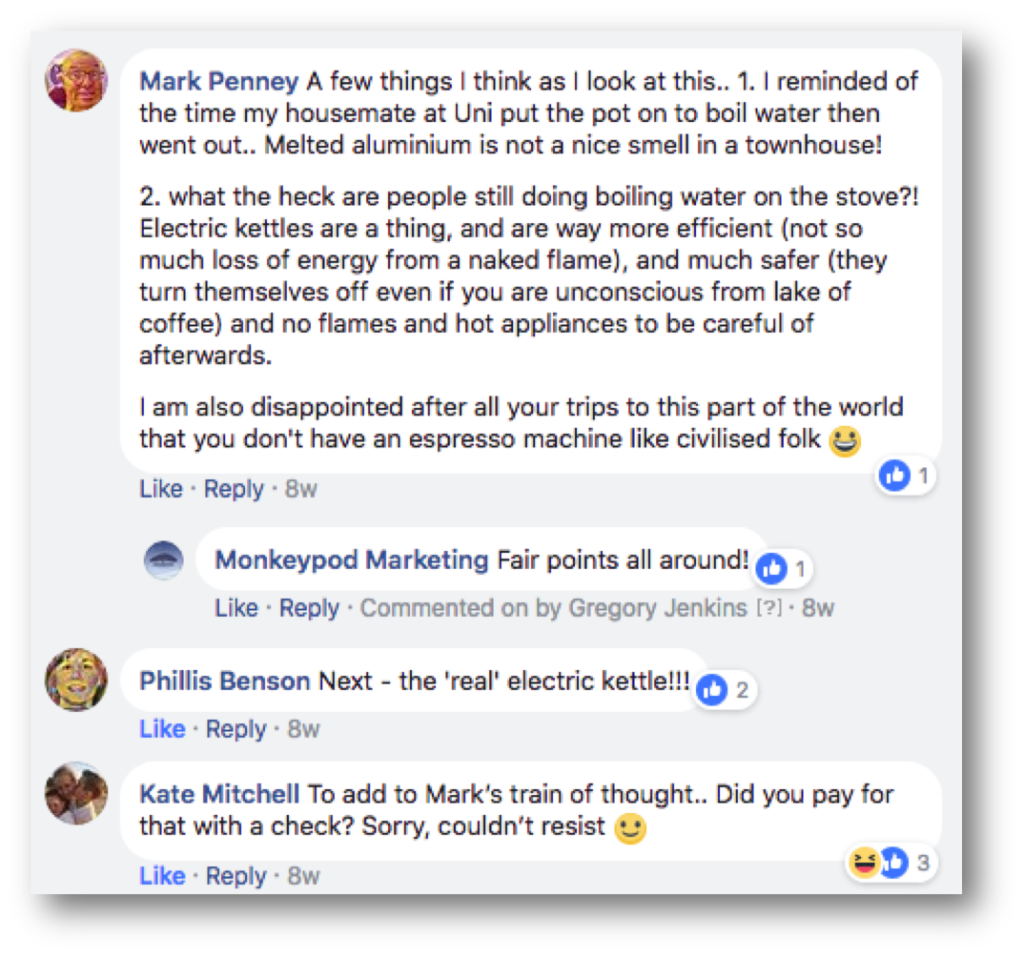
Oh how wrong I was – and the internet, being the cruel and unforgiving place that it is, wasted no time letting me know.

Some people were perfectly pleasant about it:

And some were a little more “direct”, haha:

But their points were very valid! I had upgraded my equipment, and my process, but still didn’t mean I was as efficient as I could have been.

An electric tea kettle is safer, less wasteful, and even faster.

And I think that’s the real lesson here – just because you’re better than you used to be, doesn’t mean you should pat yourself on the back and take the rest of the day off.

I had basically gone from a covered wagon to a Model T and then bragged about it on the internet.

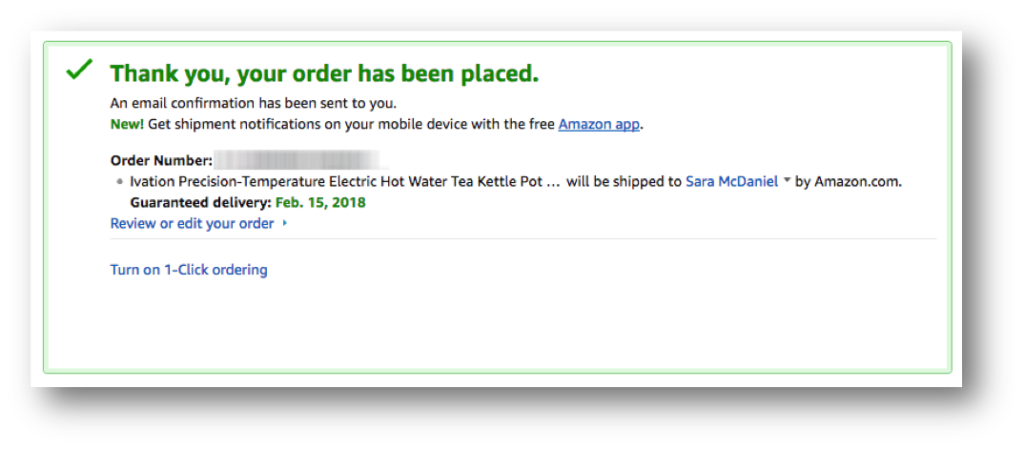
But, hey, I learned my lesson. I ordered myself a proper electric tea kettle (it should be here tomorrow).

Here’s your take away: Keep getting better.

Incremental improvements are fine, but don’t get complacent.

That goes for marketing automation and household appliances alike.

I find it takes a bit of discipline to go back over the things that are working, and actively look for ways to improve them – but I think that’s how you get ahead.

I’m excited for my new electric tea kettle – but I’m also gonna keep an eye out for whatever the next evolution in tea kettle technology may bring.


The Hustle Trap

The Hustle Trap

Happy new year ya’ll – I haven’t published a blog post in almost a month, and I’m finally okay with it.

I wasn’t though.

I was feeling guilty.

For the first week or so of the new year I was watching friends post about their goals, or send emails about how they were hustling while other people were watching bowl games – and I let it get to me.

I think it’s easy to fall into that trap.

The “hustle trap”.

I work for myself – but I still managed to feel a bit ashamed that I was spending time relaxing and visiting with family (how dare I….) while other people just like me were out there getting after it.

So I spent some time unpacking WHY I felt this way, and I ended up realizing that I was doing it to myself.

Unnecessarily. I gave myself permission to relax without owing an explanation.

I recorded a video unpacking my thoughts on this. I hope you find it valuable, let me know.

Stop Poisoning Your Customers

Stop Poisoning Your Customers

You might be poisoning your customers, figuratively, or even literally.

In May of 2017 I was diagnosed with celiac disease. In case you aren’t aware, this is the condition that means I no longer get to have gluten; ruling out pie, cake, doughnuts, beer, pasta, probably jet skis, and basically anything else resembling fun.

Yes, it’s little bit of a bummer, and it has definitely changed my life in a number of ways.

Here’s why this matters to you: Celiac disease has changed my perspective as a consumer.

And it’s much easier for me to share some gastrointestinal-driven business lessons with you than for you to wait until you have your own shiny new autoimmune disease show up and teach you all about life.

Having celiac disease means that my lens, specifically in regard to food, has changed.

The biggest change has been, predictably, that I have to ask a lot of questions. And unfortunately, what I’m discovering is that many times people with the best intentions still end up poisoning me.

Here’s the thing – celiac is more than just being gluten free. It’s not a choice so much as it is a prescription. Gluten affects my intestines, and specifically my body’s ability to process food and absorb nutrients.

It literally poisons me. And the only treatment for celiac disease is cutting out gluten completely. But the challenge that comes along with this is that not everyone knows what gluten is, or where it shows up (it’s a sneaky bugger, for sure), or how easy it is for gluten to cross-contaminate.

And to make this already fun condition even more of a party, the more you remove gluten, the worse your reaction gets when you’re accidentally exposed.

Why does this matter to you?

It matters because I’ve noticed that my trust is affected. It’s only been a few months, and already I’ve been poisoned several times.

I don’t think it’s malicious, but intent doesn’t matter one bit to the villi in my small intestine.

When I go out to eat, I have to ask questions in order to protect myself. I want to spend money with the restaurant I’m at, but more important than that, I don’t want to get sick.

Your customers are probably the same. They want to do business with you, but only if it’s also in their best interest.

That’s the goal right? I think they call that a win:win.

Most businesses have done some basic persona work to figure out who their ideal customer is. And that’s 100% important. When your ideal customer comes along, you need to be able to call them by name and let them know that you have what they need.

But I think it’s equally important to know who you don’t serve.

If I walk into a restaurant and they tell me they don’t have any gluten free options, and they even batter everything down to their napkins, that’s cool. I mean, it’s not great for me if I’m hungry, but at least I know that I can protect myself by not ordering anything.

And if I walk into a restaurant and they hand me a GF menu, with a dairy-free milkshake, a soy candle, and vegan set of crayons, well, I’m in business (they tend to lump all the restrictive diet folk in together).

But that’s exactly the confirmation I need– that they are prepared to serve me.

But the challenge that I’m running into is that it seems like most restaurants, or most servers, haven’t been trained to have a conversation about gluten’s presence on their menu. And servers, at the end of the day, are sales people.

They’re trained to sell. They want to make their customers happy. And often times, that means saying what the customer wants to hear.

The problem is that if they’re wrong, or they misunderstand the question, or are misinformed, then I’m not only paying for my dinner, but I’m paying to be poisoned.

Stop poisoning your customers.

Sometimes you’ll have to turn people away, and that’s okay. Sometimes the right thing to do is tell a customer you can’t help them.

I do know how hard it is to say no to revenue. And I know that it’s even harder when you’re a small business… during your slow season.

But I also know what it’s like to do business with someone and totally regret it. And your customers will thank you if you help them avoid making a bad decision. It’s not always public, or immediate, but they will thank you.

I help people use automation and technology to grow and scale their business. That’s what I do.

My gluten-free bread and butter is Infusionsoft education; it’s where I think I can best help people. That’s not the only thing I’m good at, but it is the niché I’ve decided to focus on (dominate, don’t dabble, right?).

Despite me trying to be super focused on education, from time to time I get requests from people for me to do other projects for them (WordPress, Copywriting, Implementation, Coaching, etc), and often times the projects are enticing, or they sound like fun, or I like the person and I genuinely want to help.

I almost always say “No”.

It’s not because I don’t want to, or don’t need the income; it’s because I know it’s not my focus.

I know enough about WordPress to probably handle some small projects, but I also know that there are people out there who are actually world class, and would do a much better job.

If you hire me to design a website for you, not only is it taking me away from what I want to be focused on, but more importantly we’re running the risk that I’ll poison you. That’s not good for me, and it’s way worse for you.

I’ve found that every business has projects like these. Projects that they continue to justify, even though they know there’s a risk.

Stop it.

My advice to all businesses (and lately, to restaurants) is to figure out exactly who you serve. And then figure out who you don’t.

Train your people to identify and handle both.

Have the discipline to say no to projects you aren’t equipped to handle. I respect the “Say yes, and figure out how” mentality, but it’s also that type of attitude that poisoned me at the Calgary Stampede this summer.

Gluten is my poison. But for your customers, it’s probably something else.

By casually saying yes to the wrong project, you could be figuratively, or literally, poisoning your customers.