


Love what you are seeing?
We have created several courses where we dive more into the technical aspects. So, if you like what you read here, you'll love our courses!!





By:
Greg Jenkins
|
February 9, 2026
|
Technology
Part of what makes Infusionsoft so powerful is your ability to be laser targeted with your communication. You can leverage not only what the person has told you about themselves, but also the actions they've taken. By using demographic and psychographic information you can really dial in on what might be of interest to a person.
And, naturally, the more targeted your communication is, the more impactful it will be.
When you're using the campaign builder, this type of segmentation is primarily done through using decision diamonds. A decision diamond, or decision node, appears on the campaign canvas when Infusionsoft decides it needs some logic in order to progress.
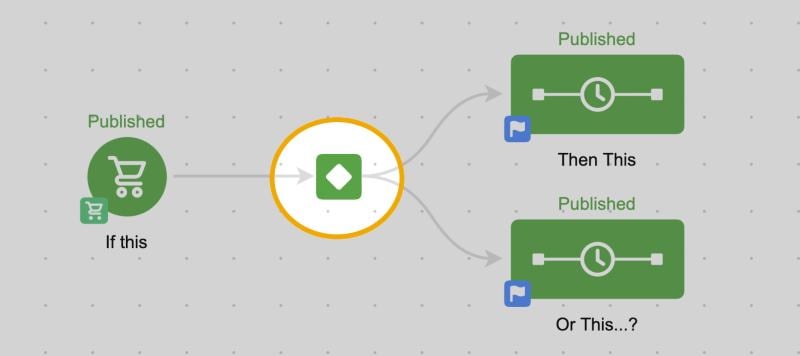
In other words, if you give Infusionsoft two paths, it's asking "When do I send them where?"
The beauty of the decision diamond is that because you're setting it up, you get to define the rules. It's not arbitrary. It's very much the opposite. You get to predict the potential scenarios and script the various outcomes you'd like to happen.
This allows you to be really detailed in your messaging because you know the exact set of criteria that a contact must have met in order to be receiving particular messages.
But, the decision diamonds aren't exactly user friendly. In fact, they're one of the more complex elements in the application.
That's why I have this robust blog post answering seven important questions about using them.
As you build rules you're expected to use logic statements, and time and time again I've seen these types of rules trip people up. Let's look at an example...
If you make the following rules:
Rules for Sequence One
If Contact's Tags doesn't contain TAG A or TAG B or TAG C or TAG D.
Rules for Sequence two
If Contact's Tags contains TAG A or TAG B or TAG C or TAG D.
On the surface, these rules look like they'd be opposites. If they don't have any of the tags they go into sequence one, and if they do have any of them they'd go into sequence two, right?
Wrong. This is a real scenario posed in the community forum, and graciously answered by Infusionsoft Developer Mike Daniels.
The way the first rule actually breaks down is like this:
If Contact's Tags doesn't contain TAG A...
OR If Contact's Tags doesn't contain TAG B
OR If Contact's Tags doesn't contain TAG C
OR If Contact's Tags doesn't contain TAG D
It's as if they are four separate rules. And therefore if the contact is missing any of those tags, then they would go into the first sequence.
So, because you're saying "doesn't contain" it means you need to use AND instead of OR. The new rules would look like this:
Rules for Sequence One
If Contact's Tags doesn't contain TAG A and TAG B and TAG C and TAG D
Rules for Sequence Two
If Contact's Tags contains TAG A or TAG B or TAG C or TAG D
Anyway, the logic statements are a little confusing, and I've seen some really bright people get tripped up by this stuff. So, that's where today's post comes in. I've got a little hack for you that my colleague Paul Sokol has elegantly dubbed Cascading Logic (Originally I called it "Strung Out Logic" which makes it sound more like a junkie drug addict and less like a useful strategy...).
So, here's how it works. Basically, you take what would be a complex decision diamond and you break it down into multiple simple decision diamonds. In a row.
This first occurred to me as I was building the teaser campaign I used to introduce Monkeypod back in May. Basically, after I announced the blog, I wanted to set expectations about what was next for everyone. But based on the relationship I had with them or the actions they had taken, I wanted to speak to them differently. This is how it would have looked:
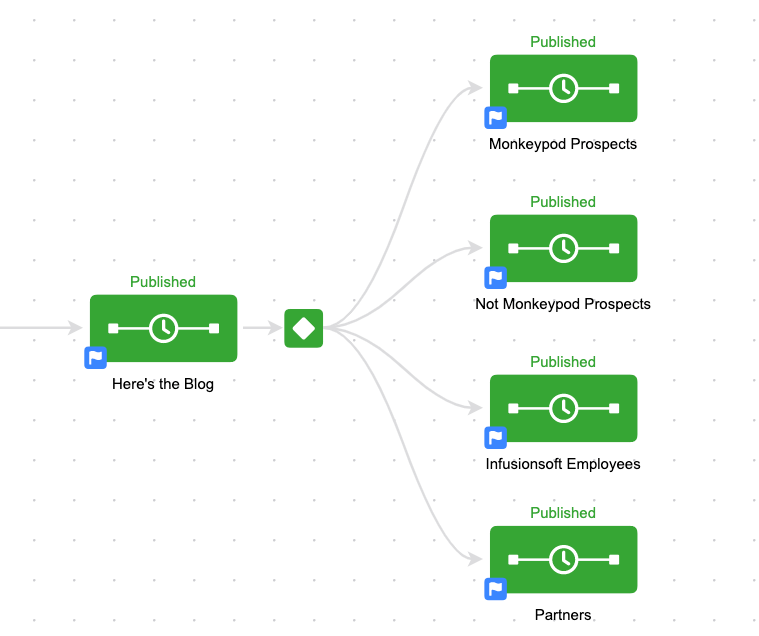
To avoid that I used a cascading logic approach and built this structure:
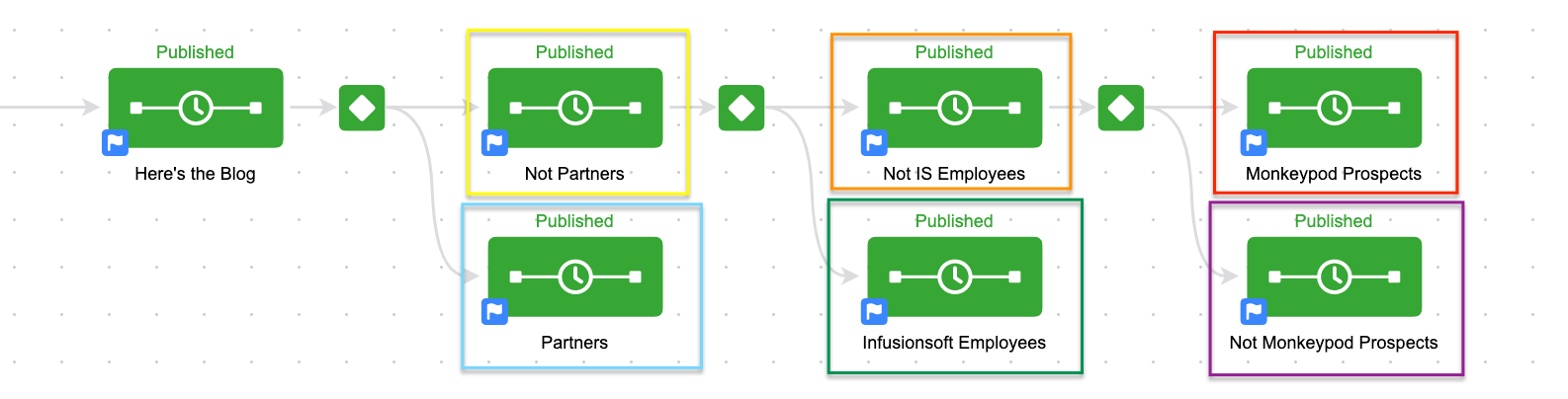
Well, with this scenario, you almost build that by default.
Anyway, I know this may not work for every scenario, and it might get cumbersome if you have an overly complex decision diamond. But I wanted you to have it in your back pocket in case you ever need it.
If have more questions about decision diamonds, or the campaign builder in general, then check out one of these resources:
We have created several courses where we dive more into the technical aspects. So, if you like what you read here, you'll love our courses!!